01
Call with year, make and model
That tells us the cell. Tell us where the car is, and whether it is behind a parkade gate.
A fob that has lost its range is usually a flat coin cell, not a broken key. A licensed mobile locksmith brings the right cell to your car, fits it without cracking the case and tests every button. Call 604-227-9083.
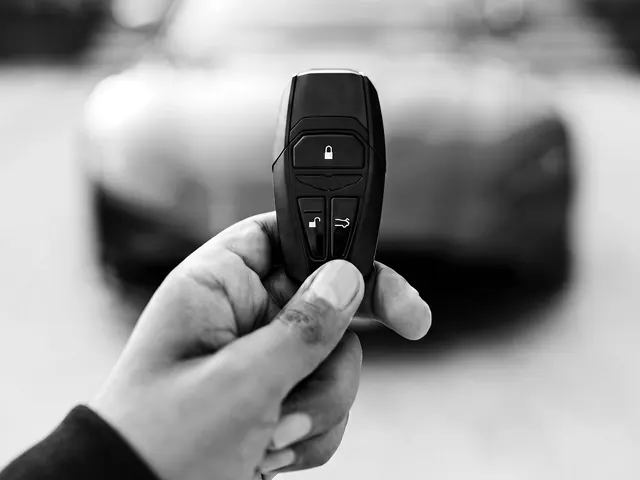 Fig. 01 — Vancouver, BC
In Vancouver the car fob and the building fob often share one keyring. Only one of them is ours.
If the car answers and the front door does not, call your strata manager.
Range is the first thing a coin cell gives up.
You rarely notice a weak cell from a parkade stall, because you press from half a metre away. You notice it from the sidewalk.
A car that sits for weeks can still flatten a proximity key, because the fob keeps listening for the car whether you drive or not.
CR2032, CR2025, CR1620 and CR1616 are the common sizes. Give us the year, make and model on the call so the correct one comes with us.
The fob is opened at its seam with the proper tool, the contacts are cleaned and the clip is checked, so the new cell actually holds.
Lock, unlock, tailgate, panic and remote start are pressed and confirmed against the car before we leave.
A few older smart keys and some European models forget the car when the power is out. We re-pair the fob in the same visit.
The emergency key inside a proximity fob opens the driver's door when the fob is dead, so we check it is there and turns freely.
If the fob itself is finished and a new cell will not revive it, we tell you at the car.
The number on a coin cell is a measurement. The sizes are close enough that the wrong one will physically fit.
A CR2025 drops into a CR2032 holder and works for a while. It is thinner, holds less charge and sits looser against the contacts, so the short-range problem comes back within weeks. That is the most common reason a fob is still weak after someone has already changed the battery. We fit the cell the fob was built for.
The total is confirmed on the call, before anyone is sent, and it does not change when we arrive.
If the fob is finished and needs replacing instead, the total for a replacement fob or a proximity smart key is confirmed on the call. See key fob replacement. Ask on the call what else can be done at the same visit, such as a spare key or a second fob.
Two places these calls usually happen, both done where the car is parked.
West End streets, lane pads in East Vancouver and driveways in Dunbar or Kerrisdale are the easy ones. The technician comes to the car, swaps the cell and tests the fob against it.
If the fob still will not work on a fresh cell, we diagnose it there and quote the fix.
We cannot badge into a gated parkade. Meet the technician at the stall, ask the concierge or building staff to let us through, or bring the car up to the curb.
A flat push-to-start fob usually still starts the car from the backup coil near the start button, so bringing it up is often possible.
That tells us the cell. Tell us where the car is, and whether it is behind a parkade gate.
Curb, driveway, stall or loading zone. Arrival and the total are confirmed on the call.
The cell goes in, every button is tested against the car, and the fob is re-paired if it dropped the car.
On a simple flip key it is a fair job. Match the cell exactly, find the seam and click it shut.
A pry in the wrong spot cracks the shell. A flattened contact clip means the cell only connects when you squeeze the fob.
A fob that no longer seals lets in damp, and water is what kills fobs. A replacement proximity key costs far more than a visit. See car key replacement.
Nearly always a lithium coin cell. CR2032, CR2025, CR1620 and CR1616 cover most vehicles. The size is printed on the old cell. If the fob is still shut, the year, make and model tells us.
There is no set range for it on our price page, so the total is confirmed on the call before anyone is sent. It does not change when we arrive.
Usually not. The cell goes in and the buttons work. A few older smart keys and some European models drop their pairing, and we re-pair them in the same visit.
Almost certainly. Hold the fob against the backup coil, usually at the start button, and the car reads it without the cell. Your owner's manual shows where it is.
Yes, once someone lets us through. Access belongs to your strata. Meet us at the stall, tell the concierge to expect us, or bring the car up to the curb.
No. Lobby, elevator and parkade fobs belong to the strata, and we never copy or program them. Contact your strata manager.
Usually the cell is the wrong size or weak, the contact clip is bent, or the fob has taken water. We find out which at the car and quote only the fix that works.
Mobile fob battery service across the city of Vancouver and the UBC area.
Each area page covers the buildings and parking we see in that part of the city.
View Service Areas ↗Tell us the year, make and model and where the car is. The price is confirmed on the call, and so is arrival.